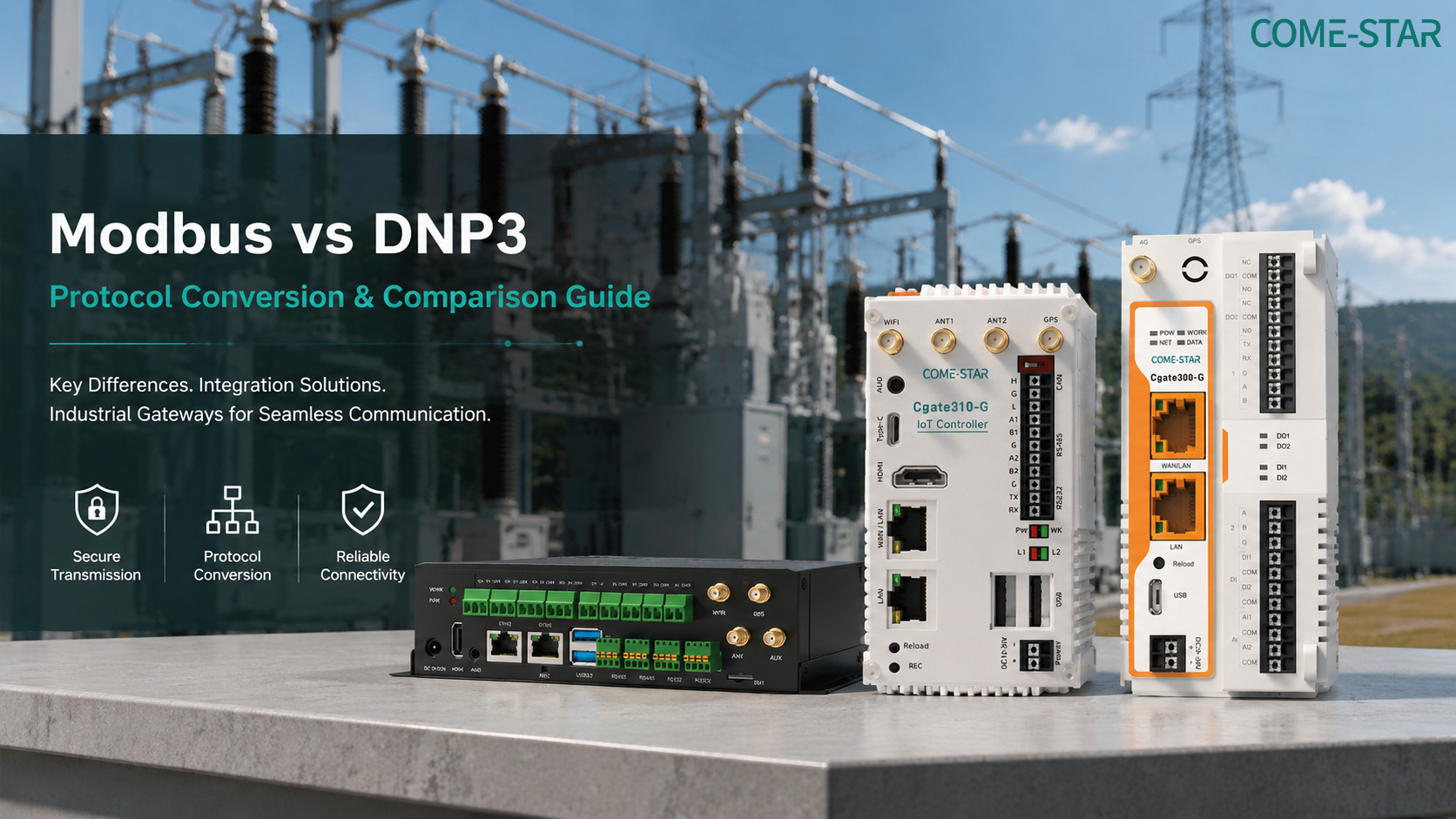
Modbus vs DNP3: Key Differences and How to Connect Them
When designing communication networks for substations, smart grids, industrial automation, or utility systems, engineers often need to decide between Modbus and DNP3.
Both protocols are widely used, but they were designed for different purposes. Modbus focuses on simple and cost-effective data communication, while DNP3 was developed for critical infrastructure applications where event accuracy, reliability, and data integrity are essential.
The right choice is not about which protocol is better, but which one fits the requirements of the system.
Modbus: Simple and Widely Used Industrial Communication Protocol
Modbus is one of the most common industrial communication protocols, widely deployed in PLCs, sensors, meters, and SCADA systems.
Its biggest advantages are simplicity, openness, and low implementation cost. Modbus devices from different manufacturers can usually communicate without licensing restrictions, making it a popular choice for industrial applications.
Modbus typically uses a Master/Slave communication model. The master requests data, and the slave responds. This polling-based communication method is simple and predictable, but it also means field devices cannot actively send information when an event occurs.
Common Modbus applications include:
- PLC and sensor communication
- Industrial equipment monitoring
- Energy management systems
- Building automation systems
However, Modbus mainly defines how data is transmitted rather than what the data represents. Engineers often need additional configuration for register mapping, scaling, and data interpretation during system integration.
DNP3: Designed for Reliable Remote Monitoring
DNP3 (Distributed Network Protocol) was developed for industries such as electric utilities, water systems, and other critical infrastructure.
Compared with Modbus, DNP3 provides more advanced features for situations where communication links may be unstable or where important events cannot be missed.
One major difference is that DNP3 supports unsolicited reporting. Instead of waiting for a master request, an outstation can automatically send important event information when a status change occurs, such as a breaker trip.
Key DNP3 features include:
- Event-driven reporting
- Accurate timestamps for Sequence of Events (SOE)
- Data quality indicators
- Object-based data organization
- Better reliability over unstable communication networks
These capabilities make DNP3 suitable for applications that require detailed event records and high communication reliability.
Modbus vs DNP3: Main Differences
Communication Method
Modbus mainly relies on polling. The master regularly requests information from devices.
DNP3 supports both polling and event-driven communication, allowing devices to report important changes immediately.
Data Information
Modbus usually transfers basic register values. Additional documentation is often required to understand the meaning, scaling, and status of data.
DNP3 includes structured data objects, timestamps, and quality information, providing richer information for monitoring systems.
Reliability
Modbus is effective in stable local networks where communication conditions are predictable.
DNP3 is better suited for long-distance communication, remote monitoring, and environments where communication interruptions may occur.
Cost and Complexity
Modbus is simpler, requires fewer resources, and is easier to deploy.
DNP3 provides more advanced functions but requires more configuration and engineering knowledge.
Can Modbus and DNP3 Work Together?
In many real-world projects, both protocols exist in the same system.
For example, field devices such as meters, sensors, and controllers may communicate through Modbus, while the SCADA system or control center requires DNP3 communication.
In these situations, protocol conversion becomes necessary. A reliable Modbus-to-DNP3 gateway can translate data between the two protocols, allowing existing Modbus devices to communicate with DNP3-based monitoring systems.
Industrial protocol gateways from experienced automation solution providers are often used for this purpose. These devices typically support Modbus RTU/TCP and DNP3 communication, while also providing industrial interfaces such as RS-232, RS-485, and Ethernet to simplify system integration.
Security Considerations
Both standard Modbus and standard DNP3 were not originally designed with modern cybersecurity requirements.
When these protocols are used over Ethernet, cellular networks, or remote connections, additional security measures may be required, including:
- VPN for secure remote access
- Firewall protection
- TLS/SSL encryption
- Secure device management methods
A protocol gateway with built-in security functions can help create a safer connection between field networks and control systems.
Choosing the Right Protocol
Modbus remains an excellent choice for simple monitoring, local automation, and cost-sensitive applications.
DNP3 is more suitable for critical infrastructure where event reporting, timestamps, and communication reliability are priorities.
In many industrial environments, the practical solution is not choosing one protocol over another, but ensuring different systems can communicate smoothly. With the help of protocol conversion technology, Modbus-based field devices and DNP3-based control systems can work together efficiently.
Source: Adapted from COME-STAR Industrial Networking Technical Blog → https://www.come-star.com/blog/modbus-vs-dnp3-protocol-converter/