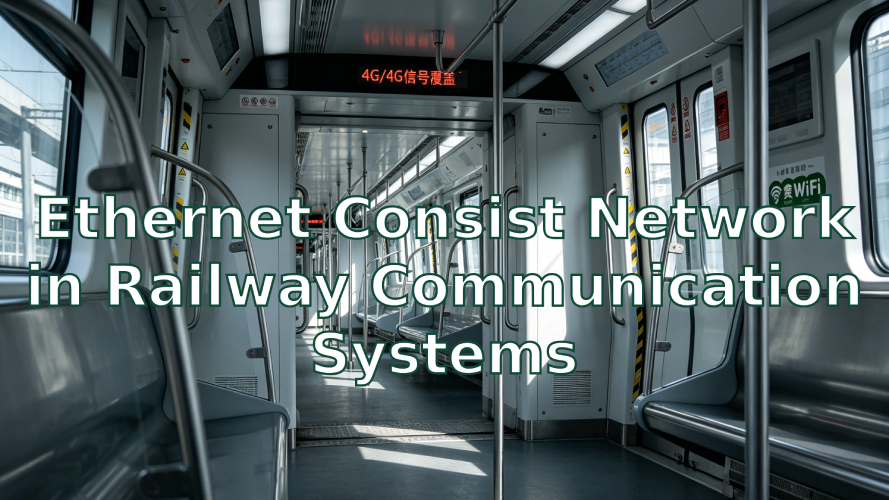
With the rapid evolution of railway systems, modern trains must handle increasing volumes of data from onboard applications such as passenger information systems, surveillance, HVAC, and control units. To support this, railway communication architectures have transitioned toward Ethernet-based networks, where the Ethernet Consist Network (ECN) plays a central role.
What Is ECN in Railway Networking
The Ethernet Consist Network (ECN) is part of the broader Train Communication Network (TCN), defined under the IEC 61375 standard.
A typical TCN architecture includes two layers:
- Train Backbone Network (WTB or ETB) for communication between train cars
- Consist Network (MVB, CAN, or ECN) for communication within a single car
ECN is the Ethernet-based consist-level network that enables high-speed communication between onboard devices within each train car. Multiple ECNs are interconnected through the Ethernet Train Backbone (ETB), allowing seamless communication across the entire train.
From Traditional Bus Systems to Ethernet-Based Architecture
Early train communication relied on bus-based systems:
- MVB (Multi-Function Vehicle Bus) for intra-car communication
- WTB (Wired Train Bus) for inter-car communication
These systems typically offer limited bandwidth (around 1 Mbps) and are not suitable for modern data-intensive applications.
In contrast, modern railway networks adopt Ethernet technologies:
- ECN replaces MVB within each consist
- ETB replaces WTB for backbone communication
This shift introduces a switched Ethernet model, enabling:
- Higher bandwidth
- Lower latency
- Point-to-point communication
- Improved scalability
These advantages are essential for applications such as real-time monitoring, video transmission, and diagnostics.
ECN Network Redundancy Topologies
To ensure reliability in railway environments, ECN networks typically implement redundancy mechanisms. Common topologies include:
- Ring Topology
Provides fast recovery by rerouting traffic in case of a link failure, often within milliseconds. - Dual Linear Topology
Uses two independent parallel links, offering redundancy with simpler deployment. - Ladder Topology
Provides multiple redundant paths but is more complex and less commonly used.
These redundancy designs are critical for maintaining uninterrupted communication in safety-critical systems.
Key Components of an ECN System
An ECN architecture consists of several types of devices working together:
1. Consist Switches
Installed in each train car, these switches connect onboard devices such as cameras, displays, and control systems.
Typical features include:
- Support for redundant topologies
- Power over Ethernet (PoE) for end devices
- Industrial-grade design for vibration and temperature resistance
- M12 connectors for secure connections in harsh environments
2. Routers
Routers enable communication between ECN segments and external systems such as control centers.
They typically support:
- Multiple IP interfaces
- VPN and firewall functions
- Network segmentation and routing
- Standard protocols such as TCP/IP, DHCP, and DNS
3. Repeaters
Repeaters extend network distance by regenerating Ethernet signals, ensuring stable communication across long train consists.
4. End Devices
ECN supports different types of end devices based on communication scope:
- Local devices operating within a single consist
- Train-level devices communicating across multiple consists
- Topology-aware devices that interact with the full train network
Examples include passenger displays, CCTV systems, door controllers, and control modules.
Why ECN Matters in Modern Rail Systems
By combining Ethernet switching, redundancy mechanisms, and standardized communication, ECN enables:
- Reliable real-time data transmission
- Scalable network expansion
- Integration of multiple onboard systems
- Improved operational safety and efficiency
Rather than deploying isolated devices, modern railway systems increasingly adopt integrated ECN-based architectures, which simplify maintenance and enhance overall network stability.
Industry Implementation Trends
In practical deployments, railway communication systems often rely on industrial-grade networking equipment designed for harsh environments. Typical characteristics include:
- Wide temperature operation
- High resistance to vibration and electromagnetic interference
- Support for redundancy protocols such as ERPS and ring-based recovery
- Integration of Gigabit or even 10G backbone connectivity
Some industrial networking vendors provide complete ECN-oriented solutions, combining switches, routers, and redundancy technologies into a unified architecture for rail applications such as:
- Tunnel monitoring systems
- Communication-Based Train Control (CBTC)
- Passenger information systems
These solutions are designed to ensure continuous operation and high reliability under demanding conditions.
Conclusion
The Ethernet Consist Network represents a key step forward in railway communication systems, enabling high-performance, reliable, and scalable data exchange within modern trains.
As railway networks continue to evolve, ECN-based architectures—combined with robust redundancy and industrial-grade hardware—are becoming essential for supporting advanced applications and ensuring long-term operational stability.
Source: Original article adapted from Come-Star
https://www.come-star.com/blog/what-is-ecn-ethernet-consist-network/