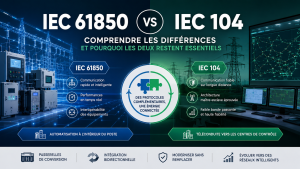
Modbus and IEC 60870-5-104 (IEC 104) are two of the most widely used communication protocols in industrial and power automation. Although both are used to transfer operational data, they were designed for very different purposes.
As industrial systems become more connected, engineers often face practical questions: Should a project use Modbus or IEC 104? What are the key differences between them? And if both already exist in a system, how can they communicate with each other?
This article provides a simplified comparison of Modbus and IEC 104, along with an overview of how protocol conversion can help bridge the gap between industrial devices and SCADA systems.
What Is Modbus?
Originally developed for PLC communication, Modbus has become one of the most widely adopted industrial protocols worldwide. Its popularity comes from its simplicity, low implementation cost, and broad device compatibility.
Modbus is commonly found in:
- PLCs
- Energy meters
- Sensors
- Inverters
- Variable frequency drives
- Building automation systems
The protocol uses a master-slave communication model, where a master device polls field devices and requests data when needed.
Why Modbus Remains Popular
Modbus offers several advantages:
- Simple implementation and troubleshooting
- Low hardware requirements
- Broad support across industrial equipment
- Compatibility with both serial and Ethernet networks
However, its polling-based architecture can become less efficient in large-scale systems where rapid event reporting is required.
What Is IEC 104?
IEC 104 is a telecontrol protocol widely used in power automation and utility networks. Unlike Modbus, it was designed specifically for communication between remote substations and centralized SCADA or dispatch systems.
IEC 104 is commonly used in:
- Power grids
- Substations
- Renewable energy facilities
- Utility monitoring systems
- Remote control centers
One of its key strengths is the ability to support spontaneous event reporting, allowing devices to actively send alarms and status changes without waiting for polling requests.
Key Benefits of IEC 104
Compared with traditional polling protocols, IEC 104 offers:
- Efficient long-distance communication
- Event-driven reporting
- Better support for historical events and timestamps
- Improved scalability for distributed systems
These capabilities make IEC 104 particularly suitable for utility-grade monitoring and control applications.
Modbus vs IEC 104: What Are the Main Differences?
Although both protocols transmit operational data, they serve different layers of an automation architecture.
Modbus focuses on communication between field devices and local controllers.
IEC 104 focuses on communication between remote sites and centralized SCADA or dispatch centers.
Some of the most important differences include:
Communication Method
Modbus relies primarily on polling. Devices respond only when requested.
IEC 104 supports both polling and spontaneous reporting, enabling faster event notification.
Data Structure
Modbus uses a simple register-based model that is easy to implement.
IEC 104 uses structured information objects that can include timestamps, quality indicators, and event information.
Deployment Scale
Modbus is ideal for local equipment communication within plants or facilities.
IEC 104 is designed for geographically distributed infrastructure where remote monitoring is essential.
Complexity
Modbus is generally easier to deploy and maintain.
IEC 104 provides richer functionality but requires more engineering effort during configuration and integration.
Why Do Modbus and IEC 104 Often Need to Work Together?
In many real-world projects, both protocols coexist.
For example, a solar power plant may use Modbus to connect inverters, meters, and environmental sensors, while the utility’s SCADA platform requires IEC 104 communication.
The same situation is common in:
- Substations
- Energy storage systems
- Wind farms
- Smart grid projects
- Distributed energy installations
In these environments, field devices generate data through Modbus, while supervisory systems expect IEC 104.
Bridging the Gap with Protocol Conversion
Because Modbus and IEC 104 use different communication models and data structures, they cannot communicate directly.
A protocol conversion gateway is typically used to bridge the two systems.
The gateway performs several important functions:
- Collecting data from Modbus devices
- Mapping registers to IEC 104 information objects
- Converting commands between protocols
- Forwarding data to SCADA and dispatch systems
This approach allows operators to integrate existing Modbus equipment into modern IEC 104-based infrastructures without replacing field devices.
Choosing the Right Approach
Modbus and IEC 104 are not competing technologies. Instead, they complement each other by serving different roles within industrial and power automation systems.
Modbus remains a practical choice for field-level communication because of its simplicity and widespread adoption.
IEC 104 continues to be a preferred solution for utility-grade remote monitoring and telecontrol thanks to its event-driven architecture and support for large-scale distributed networks.
As industrial and energy systems continue to evolve, protocol conversion gateways play an increasingly important role in connecting these two worlds and enabling seamless interoperability across mixed environments.
Source: Adapted from COME-STAR Industrial Networking Technical Blog → https://www.come-star.com/blog/modbus-vs-iec-104-protocol-conversion/