Modern substations rely on reliable communication networks to connect Intelligent Electronic Devices (IEDs), SCADA systems, RTUs, protection relays, and control centers. These communication protocols are responsible for transferring critical information such as measurements, equipment status, alarms, and control commands.
With the development of smart grids and digital substations, choosing the right communication protocol has become increasingly important. Different protocols are designed for different application scenarios, including legacy equipment integration, remote control, high-speed protection, and multi-vendor device communication.
This guide introduces several widely used substation communication protocols, including Modbus, DNP3, IEC 60870-5-101, IEC 60870-5-103, IEC 60870-5-104, and IEC 61850.
Common Substation Communication Protocols
Modbus: A Simple and Widely Used Industrial Protocol
Modbus is one of the most common industrial communication protocols due to its simple structure and wide compatibility. It is widely used in substation auxiliary systems, including power meters, UPS systems, environmental monitoring devices, and PLC-based applications.
Modbus supports both serial communication (Modbus RTU/ASCII over RS-232/RS-485) and Ethernet communication (Modbus TCP).
Advantages:
- Simple configuration and low deployment cost
- Broad support from different manufacturers
- Suitable for many industrial devices
Limitations:
- No built-in encryption or authentication
- Limited data model compared with modern protocols
- Not suitable for high-speed protection applications
DNP3: Reliable Communication for Utility SCADA Systems
DNP3 (Distributed Network Protocol) was developed for electric utility applications and is widely used in SCADA systems, especially in North America.
Unlike traditional polling-based communication, DNP3 supports event-driven reporting, allowing field devices to send important changes immediately instead of waiting for the next polling cycle. It also provides timestamped event records, which are valuable for fault analysis.
Advantages:
- Reliable over long-distance and unstable networks
- Efficient bandwidth usage
- Supports event reporting and time synchronization
Limitations:
- Basic protocol does not include encryption
- Less commonly used in IEC 61850-based digital substations
IEC 60870-5-101 and IEC 60870-5-103: Legacy Power Communication Protocols
IEC 101 is a serial telecontrol protocol commonly used between SCADA systems and RTUs in traditional substations. It is designed for reliable communication over low-bandwidth networks and remains active in many legacy power facilities.
IEC 103 focuses specifically on communication with protection relays. It enables the exchange of protection events, fault records, and relay settings between monitoring systems and protective devices.
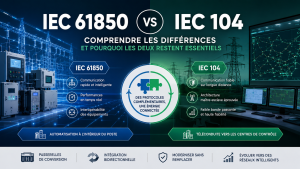
Although both protocols are still widely used, many new projects are gradually moving toward Ethernet-based solutions such as IEC 104 and IEC 61850.
IEC 60870-5-104: Ethernet-Based Telecontrol Communication
IEC 104 is the Ethernet evolution of IEC 101. It keeps the same application layer while replacing serial communication with TCP/IP networks.
Because it works over standard Ethernet, fiber networks, and WAN connections, IEC 104 is widely used for communication between substations and utility control centers.
Typical applications include:
- Remote monitoring
- Telecontrol systems
- Transmission and distribution automation
- Renewable energy integration
IEC 104 provides easier network expansion compared with traditional serial protocols, making it a popular choice for modern power system communication.
IEC 61850: The Foundation of Digital Substations
IEC 61850 is one of the most important standards for modern digital substations. Unlike traditional protocols based on simple point-to-point data exchange, IEC 61850 uses standardized object-oriented data models and Logical Nodes to describe equipment and functions.
It supports several key communication services:
- MMS: Used for monitoring, control, and data exchange with SCADA systems
- GOOSE: Enables high-speed peer-to-peer communication for protection and interlocking
- Sampled Values (SV): Provides real-time transmission of electrical measurements
The main benefits of IEC 61850 include improved interoperability, reduced wiring complexity, and easier system expansion. However, its engineering process is more complex and requires specialized knowledge.
How to Choose the Right Substation Communication Protocol?
There is no single protocol that fits every substation application. The best choice depends on factors such as:
- Existing equipment and infrastructure
- Required communication speed
- System scalability
- Cybersecurity requirements
- Compatibility with other devices
In many real-world projects, multiple protocols work together:
- IEC 61850 for digital substation communication and high-speed protection
- IEC 104 for communication between substations and control centers
- Modbus for auxiliary equipment
- DNP3 for utility SCADA applications
- IEC 101/103 for legacy systems
Why Protocol Gateways Are Important in Modern Substations
As power systems evolve, many utilities need to integrate new digital devices with existing legacy equipment. Replacing all existing devices is often expensive and impractical.
Protocol gateways provide a practical solution by enabling communication between different protocols. They can connect devices such as RTUs, PLCs, protection relays, meters, and IEDs from different manufacturers, helping utilities upgrade their systems while protecting existing investments.
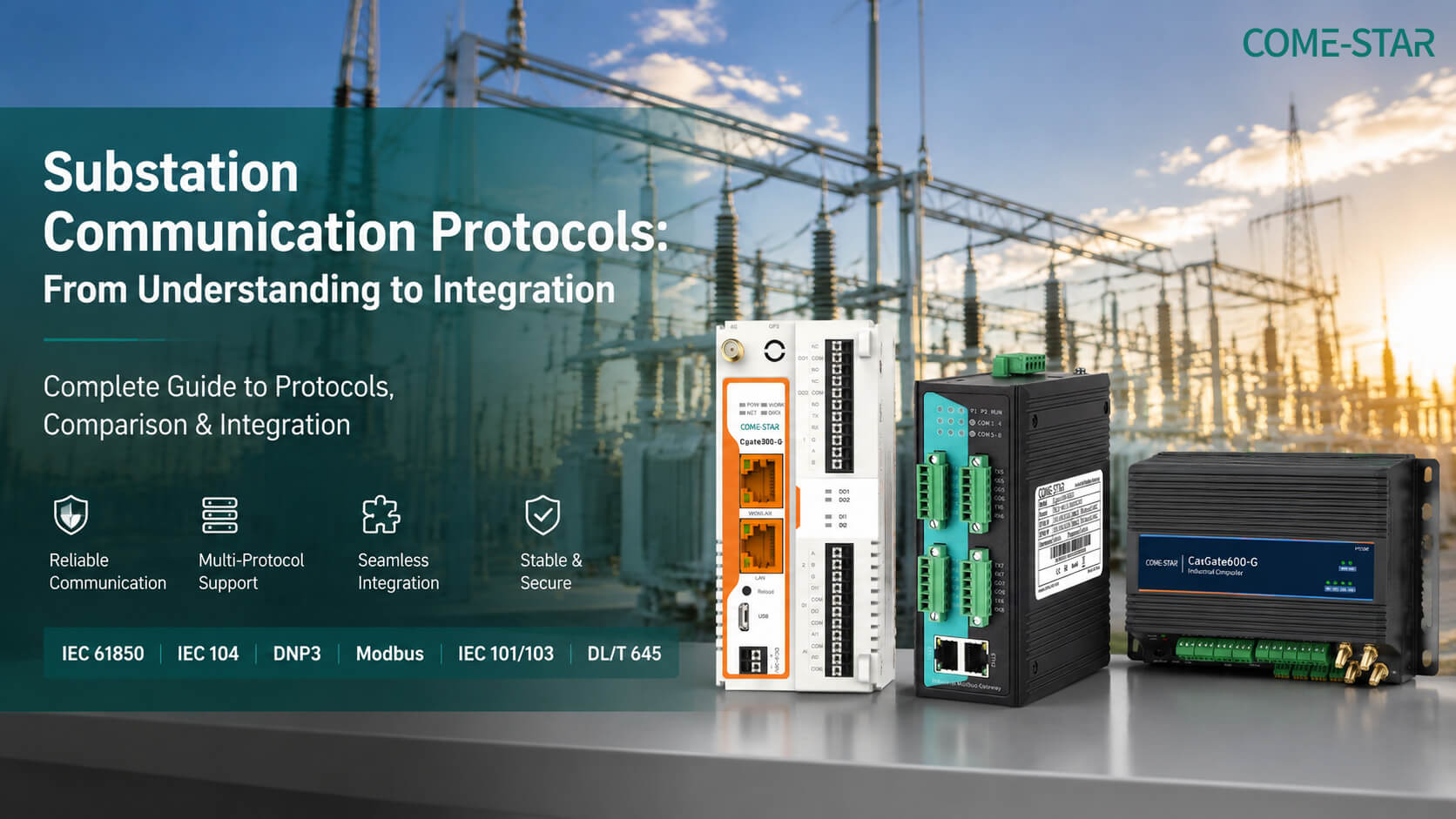
Some industrial communication solution providers, such as COME-STAR, offer protocol gateway products supporting IEC 61850, IEC 104, IEC 101, IEC 103, Modbus, DNP3, and other industrial protocols. These solutions are often used for protocol conversion, data integration, and edge-level processing in power automation projects.
Modern gateways may also include features such as:
- Industrial-grade hardware design
- Wide temperature operation
- Redundant power inputs
- Ethernet and serial interfaces
- Data filtering and local processing
- Security functions such as encryption and access control
Final Thoughts
Substation communication protocols each have their own strengths and application areas. From simple device monitoring with Modbus to advanced digital substations based on IEC 61850, different protocols continue to play important roles in power automation.
For many modernization projects, the most practical approach is not replacing existing systems completely, but building a flexible communication architecture that integrates both legacy and modern equipment through reliable protocol conversion solutions.
Source: Adapted from COME-STAR Industrial Networking Technical Blog → https://www.come-star.com/blog/substation-communication-protocols/