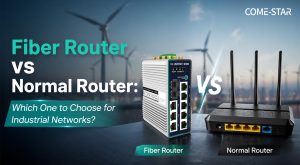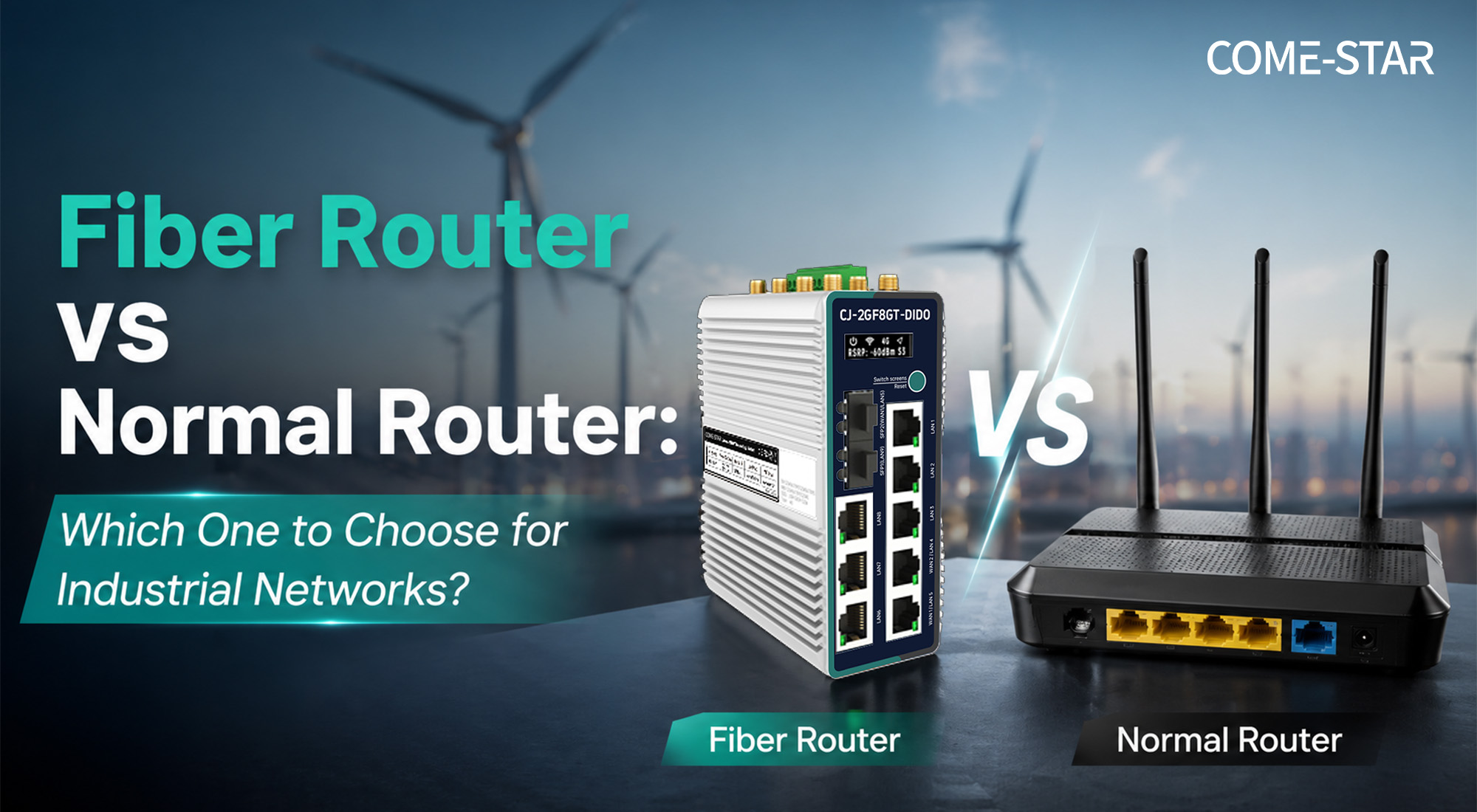
When designing an industrial network, one common question is whether a fiber optic router is really necessary or if a standard Ethernet router is sufficient.
At a basic level, the difference is straightforward. Fiber routers transmit data through optical fiber, while Ethernet routers use RJ45 ports and copper cables such as Cat5e or Cat6. But in industrial environments, the decision involves much more than just the type of cable.
Why Fiber Routers Are Used in Industrial Applications
Fiber optic communication offers several advantages that become especially valuable in demanding environments.
Long-Distance Connectivity
Copper Ethernet connections are typically limited to around 100 meters before additional switches or extenders are required. Fiber can transmit data over much greater distances, making it ideal for large facilities, railway corridors, pipelines, and mining operations.
Immunity to Electromagnetic Interference
Unlike copper cables, fiber carries data using light rather than electrical signals. As a result, it is not affected by electromagnetic interference from motors, high-voltage equipment, inverters, or other industrial machinery.
This is one reason why fiber is commonly deployed in substations, power facilities, and other electrically noisy environments.
Improved Security
Intercepting data on a fiber link is generally more difficult than tapping into a copper cable. Any physical interference with the fiber often affects signal quality, making unauthorized access easier to detect.
Advantages of Traditional Ethernet Routers
Despite the benefits of fiber, Ethernet routers remain the preferred choice in many applications.
Lower Cost
Copper cabling and RJ45 interfaces are widely available and generally less expensive to deploy.
Easier Installation and Maintenance
Ethernet networks are familiar to most technicians. Cables can be terminated quickly, troubleshooting is straightforward, and expansion usually requires minimal specialized tools.
Broad Compatibility
Most industrial devices still rely on RJ45 Ethernet interfaces, making copper-based networks easy to integrate with existing infrastructure.
Where Fiber Routers Deliver the Most Value
Fiber connectivity becomes particularly attractive in situations such as:
- Power substations and utility networks
- Wind farms and renewable energy projects
- Oil and gas fields
- Railway communication systems
- Smart mining operations
- Long-distance industrial monitoring networks
- Critical infrastructure requiring enhanced security
In these environments, longer transmission distances and immunity to interference can significantly improve network reliability.
The Best Approach Is Often Both
In practice, many industrial networks use a combination of fiber and copper.
Fiber is often used for long-distance backbone communication between sites, control centers, or remote facilities. Copper Ethernet is then used locally to connect cameras, PLCs, industrial computers, sensors, and other field devices.
This hybrid architecture helps balance performance, reliability, and deployment cost while taking advantage of the strengths of both technologies.
Final Thoughts
Fiber routers are not automatically better than Ethernet routers. The right choice depends on your environment, transmission distance, security requirements, and available infrastructure.
If your network operates in high-interference environments, spans long distances, or supports critical industrial operations, fiber connectivity can provide substantial benefits. For shorter-distance applications with existing copper infrastructure, standard Ethernet routers may remain the most practical option.
For many industrial deployments, the most effective solution is not choosing one over the other, but designing a network that combines both technologies where they make the most sense.
Source: Adapted from COME-STAR Industrial Networking Technical Blog → https://www.come-star.com/blog/fiber-router-vs-normal-router/