We talk about OT/IT integration all the time—management level, control level, field level. But when you step into a real electrical substation, the challenges become very tangible.
Legacy relays still run critical protection schemes. Copper cables stretch across cable troughs, exposed to electromagnetic interference (EMI) from high-voltage equipment. During switching events, system reliability depends on everything working flawlessly.
At that moment, one question becomes clear:
👉 Is there a more reliable way to build these networks?
There is—and it’s called power grid optical fiber. Today, it plays a foundational role in enabling smart grid fiber infrastructure across modern energy systems.
Why Smart Grid Fiber Is Essential for Modern Power Systems
Utilities worldwide are under increasing pressure to:
- Deliver reliable and efficient electricity
- Reduce environmental impact
- Modernize aging infrastructure without downtime
To meet these demands, the industry is rapidly adopting smart grid technologies, where Ethernet-based automation enables faster and more intelligent power transmission and distribution.
However, these systems generate massive amounts of real-time data. Without a communication medium that can support high bandwidth, low latency, and strong reliability, the benefits of the smart grid cannot be realized.
This is why smart grid fiber is becoming essential.
Compared to traditional cabling, power grid optical fiber provides the speed, capacity, and stability required for next-generation energy networks.
Inside a Substation: Where Fiber Makes the Difference
Electrical substations are at the heart of power transmission and distribution.
Their core functions include:
- Receiving electricity from generation sources (solar, wind, hydro)
- Increasing voltage for long-distance transmission
- Reducing voltage for safe distribution
- Managing switching operations to maintain system continuity
These operations must be performed without interrupting power supply, even during maintenance or expansion.
That’s where power grid optical fiber becomes critical.
Industrial Ethernet + Smart Grid Fiber
Industrial Ethernet is now the backbone of substation automation. It allows Intelligent Electronic Devices (IEDs) to:
- Collect real-time data from sensors and equipment
- Execute control commands with high precision
- Enable condition-based monitoring (CBM)
- Support SCADA systems for centralized management
But Ethernet performance depends heavily on the physical layer.
With smart grid fiber, substations achieve:
- Faster data transmission
- Higher reliability under harsh conditions
- Deterministic communication for protection systems
Key Applications of Power Grid Optical Fiber in Substations
1. Circuit Breaker Communication
Circuit breakers are responsible for detecting faults and rerouting power. Fiber connects breaker cabinets to control rooms over distances ranging from tens to hundreds of meters.
When a fault occurs, signals transmitted via power grid optical fiber ensure rapid response—often within milliseconds.
2. Relay Protection Systems
Relays monitor electrical conditions and trigger protective actions. When combined with smart grid fiber, they enable:
- High-speed fault detection
- Continuous diagnostics without service interruption
- Advanced reporting (fault location, event logs, oscillography)
3. Motor Protection and Monitoring
Electric motors use sensors such as RTDs to monitor temperature. Optical fiber provides electrical isolation, protecting control systems from high currents and ensuring safe operation.
In all these scenarios, response times below 100 milliseconds are critical—something only fiber can reliably support.
Why Power Grid Optical Fiber Outperforms Copper
Compared to copper, smart grid fiber offers significant advantages:
- Higher bandwidth over longer distances
- Immunity to EMI/RFI, ideal for high-voltage environments
- Smaller size and lighter weight, simplifying installation
- Enhanced security, difficult to tap without detection
- Electrical isolation, protecting equipment and personnel
In harsh industrial environments, power grid optical fiber is not just better—it is safer and more reliable.
Bridging the Gap: Extending Smart Grid Fiber to the Field
Despite the advantages of fiber, many field devices still rely on legacy interfaces such as:
- Copper Ethernet
- RS232 / RS485 / RS422 serial communication
- CANbus systems
- DSL connections in remote locations
Replacing all existing equipment is not always practical.
Instead, modern networks extend smart grid fiber through media and protocol conversion.
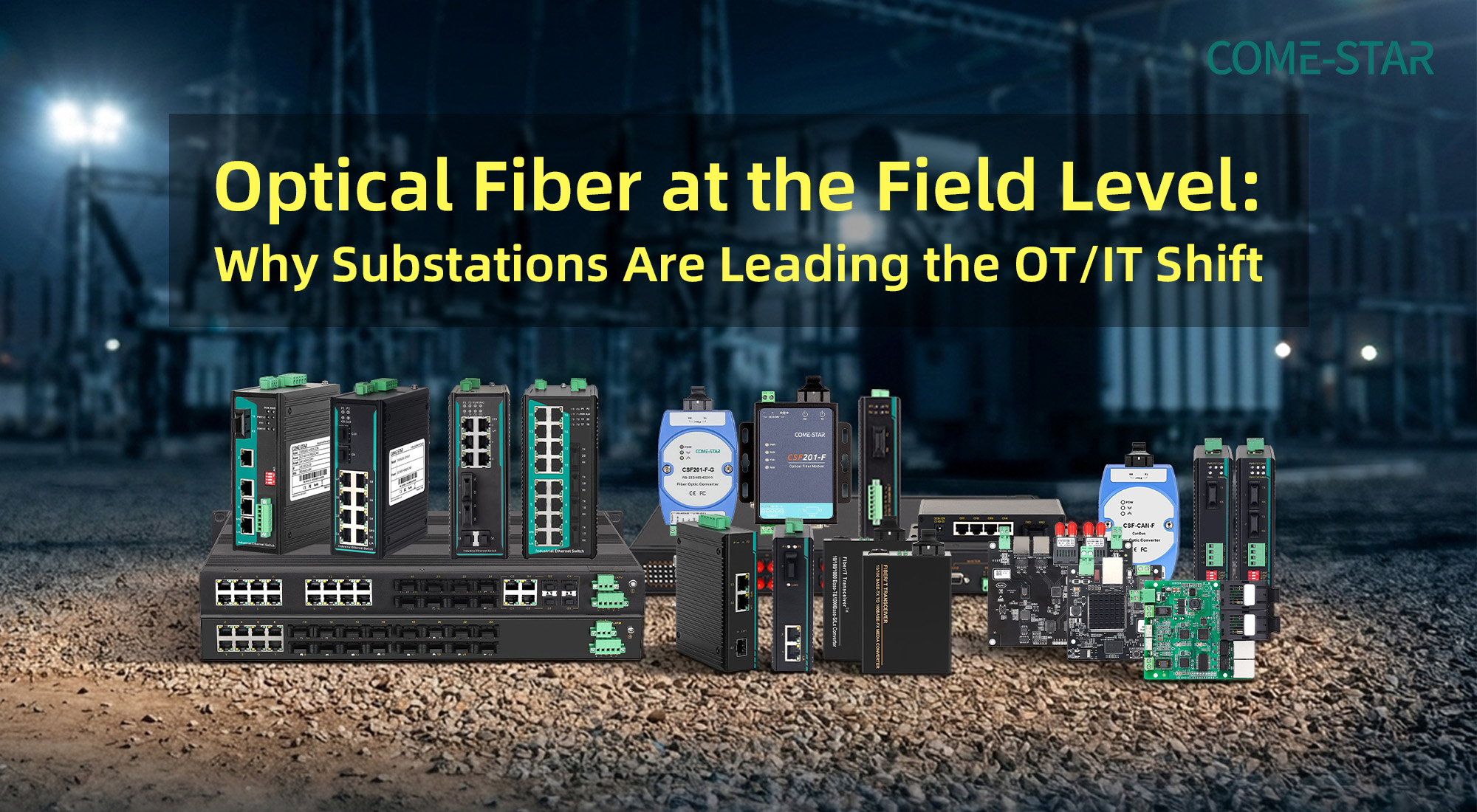
Enabling Full Integration with Fiber Conversion Solutions
To fully leverage power grid optical fiber, industrial networks require seamless integration between fiber and legacy systems.
This is achieved through:
- Industrial fiber Ethernet switches for backbone connectivity
- Fiber media converters to extend copper networks
- Serial-to-fiber converters for legacy control devices
- CANbus-to-fiber converters for transportation and automation
- DSL-to-fiber converters for remote infrastructure
These solutions allow existing devices to remain operational while becoming part of a high-performance smart grid fiber network.
Building a Future-Ready Substation Network
A modern substation or industrial OT network requires:
- A fiber backbone capable of real-time communication
- Reliable integration of diverse field interfaces
- Rugged hardware designed for harsh environments
- Scalable architecture for future expansion
When properly implemented, power grid optical fiber networks deliver:
- Faster fault detection and system protection
- Improved equipment reliability
- Safer operations for personnel
- Reduced maintenance complexity
- Seamless OT/IT integration
OT/IT Insight: Smart Grid Fiber Is the Enabler
The goal is not simply to deploy fiber—it is to build a network that is:
- Reliable
- Scalable
- Future-proof
In energy infrastructure, smart grid fiber is the foundation that enables all three.
But its true value is realized only when it extends beyond the backbone and connects directly to field devices.
Takeaway
From substations to transportation systems and industrial automation, the role of power grid optical fiber continues to expand.
👉 Smart grid fiber builds the backbone. Conversion brings the field online.
If you are designing or upgrading a network, don’t just focus on the core infrastructure. Consider how fiber connects to every device in the field—and choose solutions that enable complete, end-to-end integration.