Humidity is often underestimated in network deployment planning. However, in industrial and semi-industrial environments, high moisture levels can significantly impact the performance, reliability, and lifespan of network switches. Standard commercial switches, typically designed for offices or server rooms, may not withstand these conditions over time.
This article outlines the key risks of high humidity and practical ways to ensure stable network operation.
How High Humidity Affects Network Switches
Condensation
Temperature fluctuations can cause moisture in the air to condense into water droplets. When this happens inside a switch, it may lead to short circuits or immediate hardware failure.
Corrosion and Electrochemical Migration
Moisture accelerates chemical reactions on metal surfaces. Over time, this can cause corrosion or electrochemical migration on PCBs, forming conductive paths that result in failures.
Port Contact Degradation
Humidity can oxidize connector pins in power or Ethernet ports, reducing conductivity. This often leads to unstable connections, packet loss, or port malfunction.
Reduced Reliability
When relative humidity exceeds approximately 80%, failure rates increase due to insulation degradation and corrosion, significantly lowering overall equipment reliability.

Typical High-Humidity Application Scenarios
High humidity environments are more common than expected. Typical scenarios include:
- Coastal and Marine Areas
Ports, offshore platforms, and coastal facilities are exposed to humid air and salt spray. - Agriculture and Aquaculture
Greenhouses, livestock farms, and fish farms maintain consistently high humidity. - Cold Storage Facilities
Temperature differences often lead to condensation on equipment surfaces. - Outdoor Industrial Sites
Construction, mining, and field deployments face changing weather and moisture conditions.
Even when installed inside cabinets, long-term exposure to humid air remains unavoidable.
Key Design Features for Humidity-Resistant Switches
To operate reliably in humid environments, industrial-grade switches typically incorporate the following design improvements:
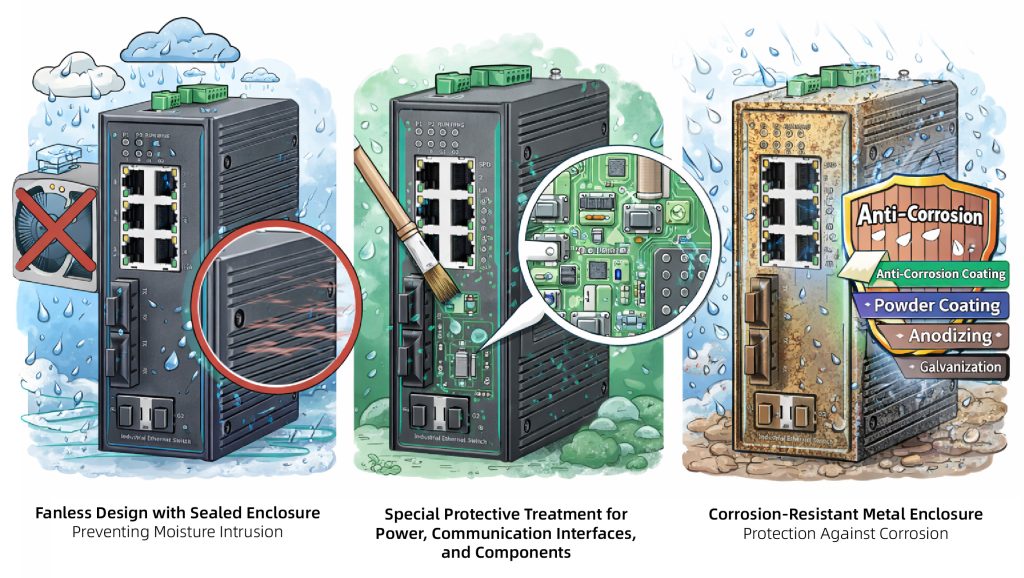
Fanless Sealed Design
Eliminates airflow paths that introduce moist air into the device, reducing internal condensation risk.
Conformal Coating Protection
Applies a protective layer to PCBs and components, preventing moisture, dust, and corrosion damage.
Corrosion-Resistant Enclosure
Metal housings with anti-corrosion treatments protect against oxidation, salt spray, and harsh environments.
Wide Humidity Tolerance
Industrial switches commonly support operating humidity ranges of 5% to 95% (non-condensing), significantly higher than commercial devices.
What Does “5% to 95% (Non-Condensing)” Mean
This specification indicates that the device can operate reliably within this humidity range as long as water does not condense into liquid form on internal components.
By comparison, most commercial switches are limited to around 60%–70% relative humidity, making them unsuitable for many industrial deployments.
Additional Protection Measures
While selecting the right hardware is critical, supplementary measures can also help:
- Use sealed or high-protection control cabinets
- Apply protective coatings where appropriate
- Install dehumidification or ventilation systems when feasible
However, in many outdoor or distributed environments, these measures are not always practical. In such cases, choosing industrial-grade equipment becomes the more reliable long-term solution.
Does High Humidity Resistance Mean Waterproof
No. Humidity resistance does not equal waterproofing.
Water protection is defined by IP ratings:
- IPX6: Protection against strong water jets
- IPX7: Protection against temporary immersion
Most industrial switches focus on dust protection and humidity tolerance rather than full waterproofing, as they are typically installed inside cabinets or enclosures.
Conclusion
High humidity can lead to condensation, corrosion, and long-term reliability issues in network switches. Standard commercial devices may fail prematurely when exposed to such environments.
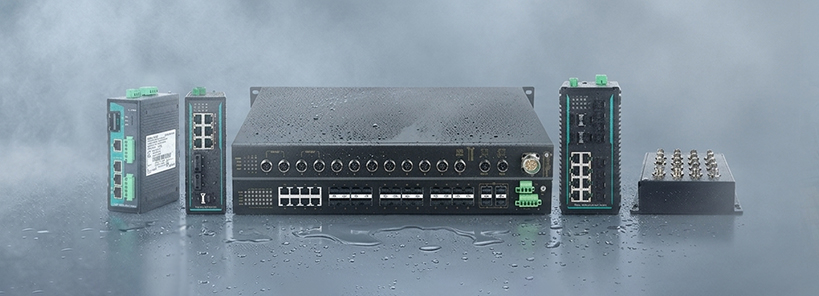
Industrial-grade switches, designed with sealed enclosures, protective coatings, and corrosion-resistant materials, provide a more robust solution. Some manufacturers offer models specifically engineered for high-humidity environments, supporting up to 95% relative humidity under non-condensing conditions and widely used in industries such as marine, agriculture, and outdoor infrastructure.
Selecting the right equipment based on environmental conditions is essential for ensuring long-term network stability and reducing maintenance costs.
Source: Adapted from COME-STAR technical materials and industry application practices.