In industrial networks, reliability is essential. From automated factories and transportation systems to energy infrastructure and security monitoring, network stability directly affects operations, safety, and efficiency. One critical factor is power stability—an unexpected power failure can disrupt an entire switch, interrupt communication, and cause costly downtime or data loss.
What Is Power Redundancy?
Power redundancy allows a network device to connect to two power sources simultaneously. If one source fails, the other continues supplying power, keeping the device running without interruption. This design is particularly common in industrial Ethernet switches used in mission-critical networks.
Two Approaches to Power Redundancy
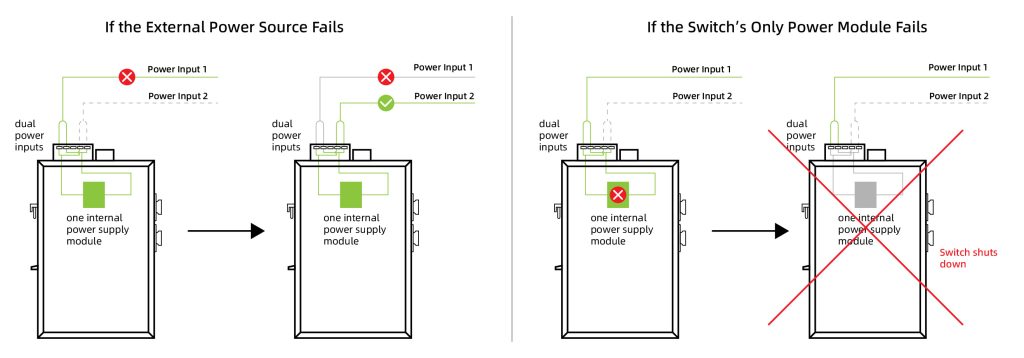
Single Power Supply with Dual Inputs
- One internal power module supports two input sources.
- Normally, only one source supplies power; if it fails, the switch automatically uses the backup.
- Some designs may reboot during switchover, while higher-end industrial switches ensure continuous operation.
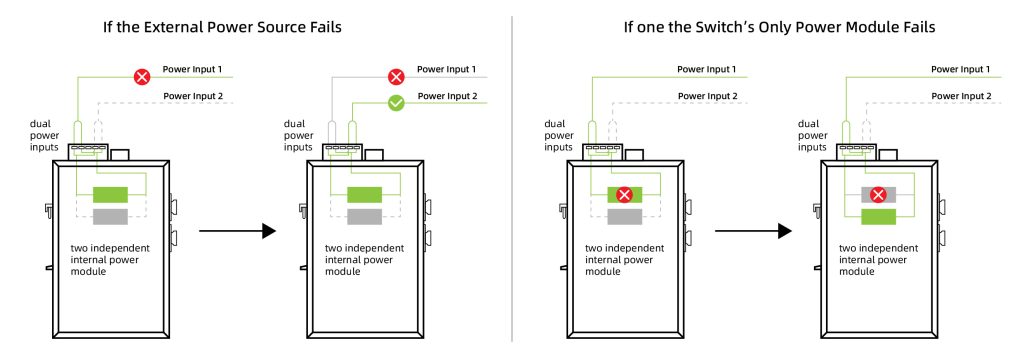
Dual Internal Power Modules (Redundant Power Supply, RPS)
- Two independent internal power modules, each with its own power source, operate simultaneously.
- Provides dual protection: backup for both external inputs and internal power modules, offering higher reliability and fault tolerance.
Why Redundant Power Matters
Redundant power inputs help industrial switches:
- Avoid single points of failure
- Prevent data interruption and loss
- Minimize operational or financial losses due to downtime
- Reduce maintenance frequency and costs
Key application areas include:
- Rail Transit & Aviation: Continuous connectivity is vital for safety and scheduling.
- Smart Factories: Automation relies on uninterrupted network operation.
- Energy & Utilities: Substations, solar, and wind systems benefit from dual power sources.
- Smart Cities & Security: Surveillance and alarm systems require stable connections.
Choosing the Right Redundant Power Switch
Factors to consider:
- Single vs Dual Power Modules: Dual modules offer extra protection, especially when AC and DC sources are used simultaneously.
- Supported Voltage Range: Ensure compatibility with available power sources.
- Hot-Swap Capability: Enables replacement of failed power sources without downtime.
Industrial-grade switches from leading manufacturers often combine redundant power inputs with features such as reverse polarity protection, power isolation, failure alarms, over/under-voltage protection, and soft-start designs, enhancing reliability even in harsh environments. Many switches also support network-level redundancy protocols, ensuring continuous operation at both hardware and network layers.
Conclusion
For mission-critical industrial networks, using switches with redundant power inputs significantly enhances reliability and reduces operational risks. Businesses in manufacturing, energy, transportation, and large-scale monitoring are increasingly adopting these designs to maintain continuous operations.
Source: Adapted from COME-STAR Industrial Switches Technical Insights, March 2026